

Your Ovaries Don’t Retire at Menopause – And Scientists Have Just Discovered Something Extraordinary!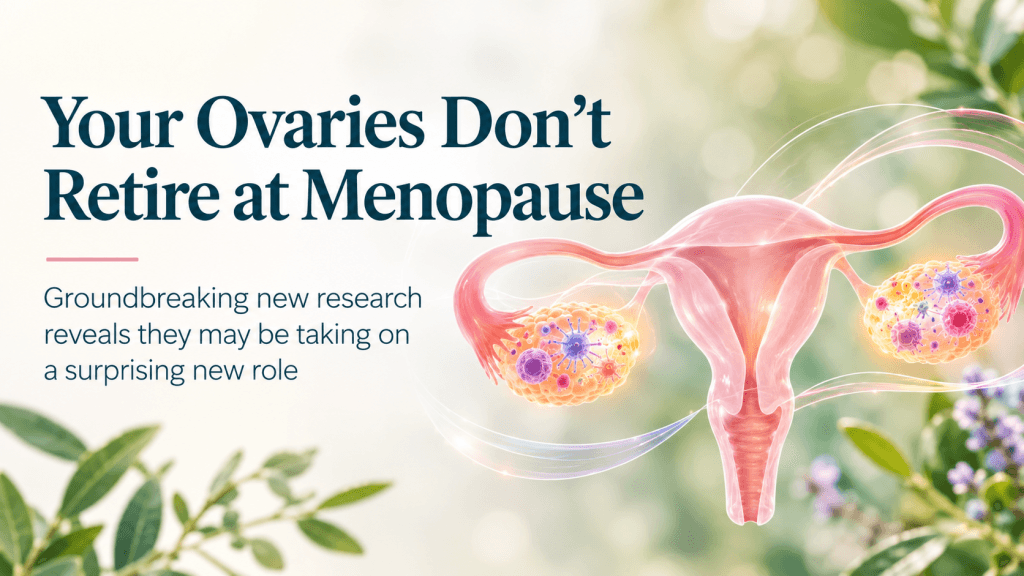
We’ve spent years being told that our ovaries gradually shut down during menopause. But groundbreaking new research suggests they may actually be starting an entirely different chapter. And what scientists are discovering could change how we understand women’s health after menopause.
For most of our lives, we’ve understood our ovaries as the organs responsible for producing eggs and the hormones that regulate our menstrual cycles.
Then menopause arrives.
Our periods stop, oestrogen levels fall, and we’re generally led to believe that our ovaries have more or less finished their job.
End of story.
Except, apparently, it isn’t.
Because researchers have recently discovered something rather extraordinary.
Our ovaries don’t simply switch off after menopause. They continue changing, adapting and potentially communicating with the rest of our bodies for decades afterwards.
And what they’re doing might be far more important than anyone previously realised.
So, What Have Scientists Actually Discovered?
In October 2026, researchers from Northwestern University and the Buck Institute for Research on Aging published a fascinating study in the scientific journal *Aging Cell*.
They examined ovarian tissue from 28 postmenopausal women aged between 50 and 75.
Rather than simply measuring hormones, the researchers looked at something much more detailed: the thousands of proteins present within ovarian tissue.
Proteins are involved in almost everything our bodies do, from maintaining healthy cells to regulating inflammation and helping organs communicate with one another.
The scientists analysed an astonishing ‘5,812 groups of proteins.’
And what they found challenged the traditional idea of the postmenopausal ovary as an inactive organ.
The ovaries of women in their 50s were biologically different from those of women in their 70s.
In fact, 117 proteins showed significant differences between the youngest and oldest groups.
Some proteins became less abundant with age, while others increased.
And many of the changes involved inflammation, immune activity and the ongoing rebuilding of ovarian tissue.
In other words, our ovaries were not simply sitting quietly, doing nothing.
They were continuing to change.
Even decades after our last period.
From Reproductive Organ to Something Entirely Different?
This is where the research becomes particularly interesting.
Another study, published in *Molecular Human Reproduction* in 2026, examined what happens to ovaries after their reproductive function ends.
Using mice at different stages of reproductive ageing, scientists discovered that the ovaries appeared to undergo a remarkable transformation.
As their reproductive role declined, their biological activity increasingly resembled that of immune-related tissue.
The researchers found greater numbers of immune cells, including T cells and macrophages, alongside changes associated with inflammation and tissue remodelling.
They described the post-reproductive ovary as developing an “immune-like identity”.
Now, that doesn’t mean our ovaries literally transform into a completely new immune organ.
But it does suggest that their biological priorities may change.
Instead of concentrating on reproduction, ageing ovaries appear to become increasingly involved in immune and inflammatory processes.
And here’s the really intriguing part.
Researchers also identified molecular changes suggesting that ovaries might continue releasing substances capable of communicating with tissues elsewhere in the body.
The scientists haven’t yet established whether this communication has beneficial or harmful effects.
But it raises an important question.
What if our ovaries are still influencing our health long after we’ve stopped having periods?
Could This Help Explain Why Menopause Affects So Much More Than Our Periods?
Anyone who has experienced menopause knows that it isn’t simply about periods coming to an end.
If only it were that straightforward.
For many of us, menopause can bring an assortment of symptoms that seem to have absolutely nothing to do with our reproductive system.
Aching joints.
Brain fog.
Changes in sleep.
Hot flushes.
Mood changes.
Unexplained fatigue.
And that frustrating feeling that our bodies are behaving differently, despite us not having changed very much at all.
We’ve long known that declining oestrogen plays a significant role in many menopausal symptoms.
But these new findings suggest that scientists may need to look beyond hormones alone when investigating women’s health in later life.
If our ovaries continue undergoing immune and inflammatory changes after menopause, could those changes influence other parts of our bodies?
Could ovarian ageing contribute to some of the wider biological changes associated with growing older?
It’s an intriguing possibility.
‘However, there’s an important distinction here: the research has not shown that these ovarian changes cause menopause symptoms.’
We cannot yet connect the findings directly to joint pain, brain fog, weight changes or any other specific menopausal complaint.
What the research does suggest is that there may be more happening within our bodies after menopause than we previously understood.
And that alone makes it worth paying attention to.
Let’s Talk About Inflammation
One of the most interesting aspects of this research is the connection between ageing ovaries and inflammation.
Inflammation isn’t necessarily a bad thing.
It’s part of our body’s natural defence system, helping us respond to infections, repair damaged tissue and protect ourselves from harm.
But inflammation can become problematic when it persists unnecessarily.
Scientists sometimes use the term *inflammaging* to describe the low-level, ongoing inflammation associated with ageing.
And this is where the ovarian research becomes especially relevant.
Both studies identified changes linked to inflammatory activity within ageing ovaries.
The human study found increasing involvement of proteins associated with immune responses and tissue remodelling.
The mouse study identified immune-cell accumulation and changes in genes involved in inflammatory signalling.
Together, these findings suggest that the ovary may participate in some of the inflammatory processes associated with ageing.
What scientists don’t yet know is whether this activity affects the rest of the body, how significant any effects might be, or whether some of these changes serve a useful protective purpose.
It’s also worth remembering that inflammation is incredibly complex.
Not every inflammatory change is harmful, and we shouldn’t assume that finding inflammation automatically means something is wrong.
Nevertheless, understanding the relationship between ovarian ageing and inflammation could eventually open new avenues for research into women’s long-term health.
What About the Brain, Bones and Heart?
This is another area that deserves attention.
Our ovaries have never operated in isolation.
Throughout our reproductive years, the hormones they produce influence numerous systems throughout the body.
Oestrogen, for example, plays an important role in maintaining bone health and affects the brain, blood vessels and many other tissues.
After menopause, ovarian oestrogen production falls dramatically, although the ovaries can continue producing some hormones, particularly androgens.
The new research suggests that hormones may not be the only way ovaries interact with the rest of the body.
Scientists identified proteins associated with potential signalling activity, raising the possibility that postmenopausal ovaries continue communicating with other organs.
Could this eventually help researchers understand why women experience changes in bone health, cardiovascular health and other aspects of ageing after menopause?
Possibly.
But it’s still very early days.
The studies haven’t demonstrated that postmenopausal ovaries directly influence these organs through the newly identified pathways.
For now, the findings offer an interesting direction for future research rather than a new explanation for established menopause symptoms.
An Unexpected Connection to Ovarian Cancer
The human study also uncovered something that researchers believe deserves further investigation.
Some of the molecular changes observed in ageing ovarian tissue resembled biological processes associated with ovarian cancer.
Before anyone becomes unnecessarily alarmed, there’s something important to understand.
‘The ovarian tissue examined in the study was healthy and non-cancerous.’
The findings do not suggest that menopause causes ovarian cancer or that the observed changes inevitably lead to disease.
Instead, researchers noticed that certain proteins and tissue changes involved in normal ovarian ageing overlap with processes that scientists have also observed in ovarian cancer.
This could eventually help researchers investigate why ovarian cancer becomes more common with age.
It might also contribute to the development of better ways to identify disease-related changes in ovarian tissue.
But that is a possibility for future research, not an immediate clinical breakthrough.
Does This Mean We Should Keep Our Ovaries After Menopause?
This is a particularly interesting question.
There are circumstances in which women undergo surgery to remove their ovaries, sometimes alongside a hysterectomy.
In the past, the idea that ovaries had little purpose after menopause may have influenced how their long-term value was perceived.
However, we already know that ovaries can continue producing some hormones after menopause.
And now, these studies suggest that they remain biologically active in other ways too.
That raises an important question for researchers.
If postmenopausal ovaries are still involved in biological processes, what happens when they’re removed?
Equally, if some age-related ovarian changes eventually prove harmful, could there be circumstances in which removing or treating ovarian tissue offers benefits?
At the moment, we simply don’t know enough.
The new studies do not provide evidence that women should routinely have their ovaries removed or that they should always be retained.
Those decisions remain highly individual and depend on factors such as age, medical history, cancer risk and the reason for surgery.
But the findings do reinforce something important.
We shouldn’t automatically assume an organ has become useless simply because its most familiar function has ended.
Why Has It Taken So Long to Discover This?
Perhaps one of the most thought-provoking aspects of this research isn’t just what scientists discovered.
It’s why we knew so little about it in the first place.
For decades, ovarian research has understandably focused heavily on fertility, egg development, menstrual cycles and reproduction.
Once women passed their reproductive years, there was comparatively less scientific attention given to what happened to their ovaries afterwards.
But think about that for a moment.
Many women experience menopause around the age of 51.
And with women now routinely living into their 80s and beyond, that means we can spend approximately a third of our lives after menopause.
That’s potentially 30 years or more with ovaries that scientists are only beginning to understand properly.
It’s a remarkable gap in our knowledge.
And one that researchers are now starting to address.
Does This Discovery Change How We Should Look After Ourselves?
For now, the findings don’t change established menopause health recommendations.
There isn’t a newly discovered supplement, diet, treatment or exercise programme that can specifically influence this proposed ovarian transformation.
And anyone claiming to have a product that can ‘reset’ postmenopausal ovarian function based on this research would be getting well ahead of the science.
However, the studies do reinforce the importance of taking women’s health seriously throughout the decades after menopause.
Looking after our bones, cardiovascular health, sleep, nutrition, mental wellbeing and physical activity remains important.
So does seeking medical advice when symptoms are affecting our quality of life.
And if we’re struggling with menopausal symptoms, we shouldn’t assume that they’re something we simply have to tolerate.
There are evidence-based treatments and approaches that can help, depending on our individual circumstances.
The exciting thing about this research isn’t that it gives us something new to buy or another supplement to add to an already overcrowded cupboard.
It’s that it may eventually give scientists a better understanding of what our bodies are doing.
And better understanding can lead to better healthcare.
Perhaps Menopause Isn’t an Ending After All.
I think one of the reasons this research resonates so strongly is that it challenges the language we’ve traditionally used around menopause.
For years, we’ve heard about our ovaries shutting down.
Our hormones disappearing.
Our reproductive systems winding up.
Almost as though a significant part of our biology has simply reached its expiry date.
But what if that picture has always been incomplete?
What if menopause isn’t simply the point at which our ovaries stop doing something?
What if it’s also the beginning of a different biological stage that we’re only just starting to understand?
These studies certainly don’t answer every question.
We still don’t know exactly what role postmenopausal ovarian activity plays in our wider health, whether the changes are beneficial or harmful, or how they might eventually influence medical treatments.
But they do tell us something important.
Our bodies don’t stop being biologically interesting once our reproductive years are over.
And perhaps it’s time scientific research reflected that more consistently.
Because menopause isn’t the end of our story.
And, as it turns out, it might not be the end of our ovaries’ story either.
Free 28-Day Mid-life Reset Journal
Menopause can sometimes leave you wondering, “Is this normal, or is it just me?” The 28-Day Midlife Reset Journal is a simple way to start noticing what’s really happening in your body.
Over 28 days, you can track your symptoms, sleep, mood, supplements and general wellbeing, helping you spot patterns, recognise changes and understand your own menopause experience a little better.
No complicated routines. No pressure to be perfect. Just a few minutes each day to check in with yourself.
Download your FREE copy and start your 28-day reset today.
The Research Behind This Article
This article is based on peer-reviewed scientific research published in 2026.
**1. The Human Ovary Exhibits Dynamic Molecular Remodeling in the Decades Post-Menopause**
Published in *Aging Cell*, October 2026.
Researchers from Northwestern University and the Buck Institute for Research on Aging examined ovarian tissue from 28 postmenopausal women, identifying age-related changes in thousands of proteins.
[Read the full research paper](https://pmc.ncbi.nlm.nih.gov/articles/PMC13662414/)
**2. The Post-Reproductive Ovary Shifts from a Reproductive to an Immune-Like Organ**
Published in *Molecular Human Reproduction*, 2026.
This animal study identified changes in ovarian immune activity and inflammatory signalling after reproductive ageing.
[Read the research paper](https://academic.oup.com/molehr/article/32/2/gaag038/8705536)
**3. Northwestern University Research News**
A helpful explanation of the human study, including comments from the scientists involved.
[Read Northwestern University’s research announcement](https://news.northwestern.edu/stories/2026/10/the-ovary-doesnt-retire-after-menopause?fj=1)
*Please note: This article is intended for general information and education. The research discussed is still emerging and does not establish new treatments or medical recommendations. Always consult an appropriately qualified healthcare professional for advice about your individual health.*