

Is It Hot in Here, or Is It Just Me?
There was no dramatic moment when menopause arrived at my house carrying a suitcase.
No knock at the door.
No official letter.
No helpful notification on my phone saying:
Your hormones will begin behaving strangely on Tuesday. Please make the necessary arrangements.
It was much sneakier than that.
Things just started happening.
Little things at first.
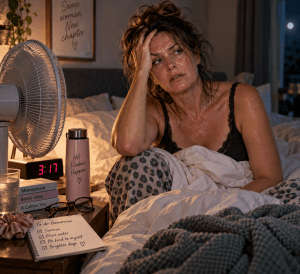
I would wake up ridiculously hot despite the fact that nobody else in the house seemed to be experiencing an unexpected tropical climate.
I’d throw the duvet off.
Five minutes later I’d be cold.
Duvet back on.
Hot.
Duvet off.
Cold.
Duvet on.
By 3 a.m., I’d essentially completed an entire upper-body workout using a king-size duvet.
Then there was sleep.
Or rather, there wasn’t.
I’d always assumed insomnia meant lying awake because you couldn’t fall asleep.
Mine developed another technique entirely.
I could fall asleep perfectly well.
Then my body would wake me at approximately 3:17 a.m. for absolutely no reason whatsoever.
And once awake, my brain would immediately clock in for its shift.
Did I reply to that email?
Where is that thing I haven’t needed since 2018?
Why did I say that embarrassing thing in 1996?
I should probably sort the kitchen cupboard out.
What actually happens to old socks?
And then, inevitably:
Why can’t I sleep?
An excellent question to ask yourself repeatedly when you can’t sleep.
Apparently, I’m far from alone. Sleep problems are common during perimenopause and menopause, and night sweats can make them worse.
That was one of the first things I discovered when I eventually stopped treating each strange new development as an entirely separate malfunction and started wondering whether they might actually be connected.
Because nobody had warned me quite how many things could be connected.
I knew about hot flushes.
Everybody knows about hot flushes.
Menopause, as presented to us for years, seemed to consist of a middle-aged woman suddenly looking warm and waving a folded magazine at her face.
That was apparently the entire curriculum.
Nobody mentioned that I might walk upstairs and arrive on the landing with absolutely no idea what I’d gone up there for.
Nobody mentioned aching joints.
Or changes in sleep.
Or concentration.
Or mood.
Or skin.
Or hair.
Or the possibility that my bladder might suddenly become an unreliable friend.
That particular discovery is especially enjoyable when you’re out with friends.
You know the sort of evening. Everyone is talking at once, somebody tells a story she absolutely should not be telling in public, and you start laughing.
Proper laughing.
The sort where you can’t breathe.
Except somewhere around midlife, laughter can acquire an additional element of jeopardy.
You are no longer simply enjoying the joke.
You are also conducting a rapid internal risk assessment.
How full is my bladder?
How far away is the toilet?
Can I safely continue laughing?
There comes a point when you realise you are no longer saying, “Stop, you’re killing me.”
You’re saying:
“Stop. Seriously. STOP.”
For entirely different reasons.
Nobody puts that on the menopause posters.
So… what actually is happening to me?
Once I’d finally accepted that my body wasn’t simply collecting unrelated complaints as a hobby, I started reading.
And one of the first things I realised was that I’d been using the word menopause to describe the whole thing.
It isn’t quite that simple.
Perimenopause is the transition leading up to menopause. Hormone levels fluctuate and periods often begin to change. They might become more frequent, less frequent, heavier, lighter or simply decide that calendars are now optional.
Menopause itself is technically a point in time: you’ve reached it when you haven’t had a period for 12 months, assuming you’re not using hormonal contraception that affects your bleeding.
After that, you’re postmenopausal.
Simple.
Well, the terminology is simple.
The experience can be anything but.
Some women barely notice the transition.
Others are hit by symptoms that affect work, relationships, sleep and everyday life.
And some of us seem to open the menopause symptom menu and accidentally tick:
Select all.
The more I read, the more things began falling into place.
Hot flushes? Yes.
Night sweats? Yes.
Sleep problems? Absolutely.
Brain fog and concentration problems? Hello.
Joint aches?
Wait.
JOINTS TOO?
Apparently so.
Changes in libido?
Yes.
Vaginal dryness and discomfort?
Yes.
Needing to pee more frequently, recurrent urinary symptoms or having less control over when you pee?
Also yes.
At this point I began to feel that the more useful question wasn’t:
What can menopause affect?
It was:
Is there anything it has decided to leave alone?
And this was where my attitude towards the whole thing started changing.
Not because the symptoms magically disappeared.
They didn’t.
But because information removed some of the fear.
There is an enormous difference between:
Something strange is happening to my body
and
I understand what might be happening to my body, and I know what I can do next.
That’s really why I’m writing this.
Not because I’ve cracked menopause.
I haven’t.
If somebody has cracked menopause, I’d quite like her phone number.
I’m writing because I wanted straightforward information.
Not miracle cures.
Not somebody on social media telling me that one obscure berry would balance all my hormones by Thursday.
Not somebody else telling me that everything I ate was inflammatory, toxic, ageing me, destroying my metabolism or probably responsible for the collapse of Western civilisation.
I wanted to know:
What’s actually happening?
What does the evidence say?
What can I realistically do?
When should I speak to a doctor?
And, increasingly:
Why does looking after myself seem to require so much stuff?
We’ll come back to that one.
The changing rulebook
One thing I wish I’d understood earlier is that menopause isn’t simply about periods stopping.
Oestrogen and other hormonal changes can affect systems throughout the body, which helps explain why the experience can feel so bewilderingly varied.
And symptoms don’t necessarily arrive together.
One might appear.
Another disappears.
A third turns up six months later without an invitation.
This makes menopause remarkably good at convincing you that every new symptom must be something completely unrelated.
That doesn’t mean we should automatically blame everything on hormones, though.
This became one of my rules while researching this book:
Menopause can explain a lot. It doesn’t explain everything.
New, persistent or worrying symptoms deserve proper attention.
Bleeding after menopause, for example, needs medical assessment rather than being filed under probably hormones.
I know this one from experience.
I’d gone a whole year without a period.
Twelve months.
I’d done my time.
As far as I was concerned, my uterus and I had reached an agreement. It had retired from active service and I was perfectly happy for it to spend the rest of its days pursuing quieter interests.
Then I bled.
Excuse me?
There is something particularly irritating about a period turning up after twelve months away. Like an unwanted house guest appearing on the doorstep saying:
“Surprise! Thought I’d pop back.”
No.
You left.
We’d moved on.
Fortunately, instead of simply putting it down to menopause, I told my doctor.
She took it seriously and referred me to hospital for a scan. While I was there, they decided that, to be safe, they would also take a biopsy from my uterus.
I won’t be adding that particular experience to my list of recommended midlife leisure activities.
It wasn’t pleasant.
But looking back, what I remember most strongly isn’t the discomfort. It’s how reassured I felt that it was being taken seriously.
The NHS investigated it properly.
The results came back clear.
And that was an enormous relief.
My mischievous returning period turned out to be nothing sinister.
But—and this is the important bit—it might not have been.
I’m very glad I didn’t dismiss it because I’d heard that menopause makes periods unpredictable. Once you’ve gone 12 months without a period, bleeding afterwards is classed as postmenopausal bleeding and should be checked, even if it happens only once or there’s only a small amount.
So that’s one piece of advice I can give you from personal experience rather than research:
Don’t ignore the comeback tour.
If you’ve reached menopause and bleeding subsequently makes an unexpected reappearance, tell your GP.
Hopefully, like me, you’ll eventually be told that everything is fine.
But knowing everything is fine is considerably better than sitting at home hoping it is.
And if something else doesn’t feel right, I’d rather be the woman who asked her GP than the woman who didn’t because she worried she was making a fuss.
We’re allowed to make a fuss about our own bodies.
Preferably a polite fuss.
But a fuss nonetheless.
The conversation we should have been having
The funny thing is that once I started talking openly about menopause, other women started talking too.
And then the stories came out.
“Oh, I had that.”
“Wait until I tell you what happened to me.”
“I thought I was the only one.”
“My knees suddenly started hurting.”
“I couldn’t remember words.”
“I couldn’t sleep.”
“I suddenly couldn’t tolerate things that had never bothered me before.”
And my personal favourite:
“Why did nobody tell us any of this?”
Exactly.
Why didn’t they?
We can talk about periods.
Pregnancy.
Childbirth.
Contraception.
Yet somehow enormous numbers of women arrive at another major reproductive transition armed with little more than the knowledge that at some point we’ll stop having periods and possibly become quite warm.
That’s not enough.
So this book is the conversation I wanted.
We’ll talk about food without turning eating into a full-time job.
We’ll investigate protein and why suddenly everybody appears to want me to eat more of it.
We’ll look at muscle, bones and strength.
We’ll venture into the cupboard of supplements and find out which ones have reasonable evidence behind them, which are interesting but uncertain, and which may have been blessed mainly by the marketing department.
We’ll talk about collagen.
Creatine.
Magnesium.
Vitamin D.
Vitamin C.
Zinc.
Hyaluronic acid.
Turmeric.
Ashwagandha.
And quite a few others.
We’ll talk about aching joints, skin, hair, sleep and brain fog.
We are also going to talk about vaginas.
Properly.
We’re grown women. We can cope.
We’ll talk about urinary changes, sex and the things that have traditionally been discussed in whispers despite affecting enormous numbers of women.
We’ll look at HRT and non-hormonal approaches without turning it into a competition in which you have to join a team.
And we’ll talk about protecting the woman we’re going to be in another ten, twenty or thirty years—not just getting through whatever symptom is annoying us today.
I don’t want to emerge from menopause simply having survived it.
I’d quite like to be strong.
Healthy.
Capable.
Still laughing with my friends.
Even if I do have to cross my legs occasionally when the laughing gets out of hand.
My first midlife reset
So this is where my diary really begins.
Not with a dramatic transformation.
Not with a cupboard full of expensive products.
Not with a promise to become a completely different woman.
Just with questions.
Lots of them.
I started paying attention to my body rather than being irritated with it.
I started looking at what I was eating.
How much protein I was actually getting.
Whether I was doing enough to maintain muscle.
What happened to bone health after menopause.
Why my joints sometimes felt approximately ninety-seven years old when the rest of me decidedly wasn’t.
And then I started looking at supplements.
That opened an entirely new can of worms.
Or, more accurately, approximately twelve tubs, seven bottles, three powders and something with a pipette.
But before we get to The Great Supplement Takeover of My Kitchen Worktop, there was another discovery waiting for me.
Apparently, one of the most important things I could do for my future health was to look after my muscles.
Excellent.
Just when I’d become quite attached to sitting down.
