

Why Britain’s beaches, lakes and rivers may offer more than an ice bath—plus how to enjoy the cold without becoming a cautionary tale on the local news.
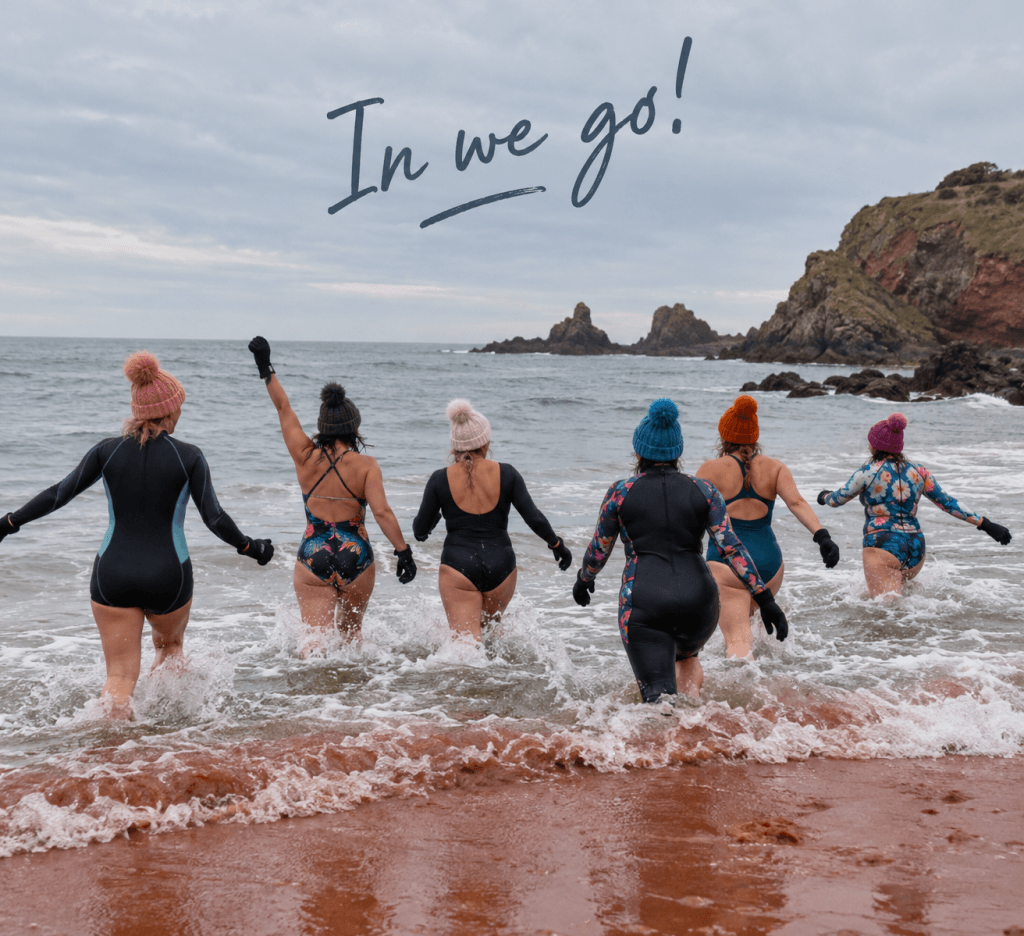
There is a particular kind of British optimism involved in standing on a beach in February wearing a swimming costume, a woolly hat and the expression of somebody who has made a terrible administrative error.
The Atlantic is pewter-grey. The wind has found the one gap in your changing robe. Sensible people are walking dogs in waterproof coats. Yet here you are, preparing to enter water so cold that your toes ar e already objecting wildly.
Then you go in.
There is gasping, possibly swearing, and a brief moment when every thought except THIS IS COLD leaves your head. But the breathing settles. The horizon expands. You move through actual water beneath an actual sky, and when you emerge—pink, exhilarated and unable to operate a bra clasp with your temporarily incapacitated fingers—you feel magnificently alive.
This is the appeal of year-round sea and wild swimming. It is exercise, nature, companionship, challenge and cold-water immersion bundled into one bracing package. It can be wonderful. It can also be dangerous if enthusiasm gets ahead of knowledge.
So, before we fling ourselves towards the nearest estuary in the name of “wellness”, let us look at what cold water may genuinely offer, why the sea can feel more rewarding than an ice bath or shower, and how to do it without requiring assistance from a lifeboat crew.
First, what counts as wild swimming?
Wild swimming generally means swimming or dipping in natural open water: the sea, a lake, river, reservoir or tidal pool. “Open-water swimming” is the broader, slightly more official-sounding term. “Cold-water swimming” refers to the temperature rather than the location.
In Britain, the categories overlap because much of our open water is cold for most of the year. The RNLI treats water below 15°C as cold—meaning the UK can provide cold-water therapy with remarkable efficiency and very little regard for the calendar.
A “swim” need not involve charging across a bay in neoprene like an ambitious seal. It might be a short, waist-deep dip close to shore. In winter, a brief immersion can be plenty. Staying in longer is not evidence of superior character; sometimes it is simply evidence that somebody has misunderstood the assignment.
Why are people so keen on being voluntarily cold?
Cold water creates an immediate physiological stress response. Sudden immersion can trigger an involuntary gasp, rapid breathing, a rise in heart rate and an increase in blood pressure. Stress hormones are released, and attention snaps firmly into the present.
That helps explain the famous post-swim “buzz”. You cannot simultaneously worry about next Thursday’s dentist appointment while the North Atlantic is trying to numb your entire body. Cold water is an extremely persuasive mindfulness teacher.
Many regular swimmers report better mood, reduced stress, increased confidence and a sense of wellbeing. Research is encouraging, but it is not yet strong enough to support every exuberant claim made beside a beach hut. Studies are often small, observational or affected by obvious complications: outdoor swimmers may also exercise more, spend time in nature, belong to friendly groups and drink tea from excellent flasks. Scientists then have the difficult job of working out which part produced the benefit.
A systematic review of cold-water immersion studies found some promising effects on stress, sleep and quality of life, but results varied, and the researchers highlighted important methodological limitations. In plain English: something interesting may be happening, but cold water has not been scientifically confirmed as a cure for everything from low mood to a difficult family WhatsApp group.
Wild swimming should therefore be viewed as a potentially helpful wellbeing activity—not a replacement for medical or psychological treatment.
The benefits come as a package deal
The sea’s advantage may not be that Atlantic water contains a secret therapeutic ingredient unavailable from the bathroom tap. Its appeal is that several useful experiences arrive together.
It gets the whole body moving
Swimming provides cardiovascular exercise while water supports the body and reduces impact on many joints. The resistance of water makes the muscles work, whether you are swimming front crawl or performing the less elegant but entirely valid “head-up breaststroke while avoiding seaweed”.
A short winter dip may not be long enough to deliver a major fitness session, but regular open-water swimming in milder conditions can help build stamina and whole-body endurance. It still does not replace all land-based strength or weight-bearing exercise, particularly for bone health, but it can be a valuable part of an active life.
Nature is doing some of the work
An ice bath offers cold. A cold shower offers cold plus shampoo. The sea offers cold, movement, daylight, weather, space and a view that does not include the discoloured bathroom grout.
Time spent in natural environments is associated with wellbeing, while outdoor activity can create a welcome sense of perspective. The sea is bigger than your washing pile, indifferent to your cleaning routines and unimpressed by your unread emails. For ten minutes, this can be tremendously restful.
Every swim is also different. The water changes colour; the tide moves; birds appear; the sky performs something theatrical. Even on a grey morning there is sensory richness: salt on the lips, pebbles underfoot and the sound of waves rather than a podcast telling you to optimise your mitochondria.
It provides challenge without a scoreboard
Getting into cold water requires a small act of courage. Repeating it can build confidence—not necessarily because cold exposure creates magical resilience, but because you repeatedly do something difficult, remain calm, and come out safely.
That lesson can travel: discomfort is not always catastrophe; panic can settle; you can choose to leave; and preparation matters. The goal is not to overpower the water. The goal is to work with it without becoming foolishly competitive.
It can be wonderfully social
Wild-swimming groups have flourished around the UK. They provide companionship, local knowledge and people who understand why you are wearing three jumpers while clutching a mug of tea with both hands.
The ritual matters: checking conditions, walking to the water, encouraging newcomers, swimming together and conducting a post-dip analysis of whose toes have returned to service. Loneliness rarely improves because somebody has bought a more advanced ice barrel. A regular group, however, can give structure and belonging as well as a safer way to swim.
Sea swim, ice bath or cold shower: which is “best”?
It depends on what you mean by best. There is no convincing evidence that plunging into the Atlantic creates a uniquely superior cold response. If your only goal is controlled cold exposure, a bath or shower is easier to measure and generally avoids waves, currents, boat traffic and suspicious foam.
But if your goal is enjoyable, repeatable wellbeing, open water may offer a richer combination.
Cold shower: the sensible starter
A cold shower is cheap, convenient and controllable. You can reduce the temperature gradually and stop instantly. There is no tide table, tow float or changing robe, and the chances of being carried towards France are reassuringly low.
It is also less immersive. You remain in your bathroom, negotiating with a shower head that seems determined to direct icy water at one shoulder blade. There is no swimming, nature, or community unless your household has unusually sociable bathing arrangements.
Cold showers may suit people who want a short alertness ritual or a low-commitment introduction. They are not risk-free for everyone, but they are usually easier to control than full-body immersion.
Ice bath or cold plunge: efficient but rather clinical
A plunge pool or ice bath surrounds more of the body, creating a stronger and more uniform cold stimulus. Temperature and duration can be controlled, which is useful in sport and research. It can also be done at home—assuming you have space, money and no emotional attachment to using your wheelie bin for plunging purposes.
Ice baths are popular for recovery after intense exercise, although routine cold immersion immediately after strength training may not suit every training goal. For general wellbeing, the evidence is still developing. Colder is not automatically better, and extreme temperatures can increase risk without adding proven health benefits.
An ice bath also removes many of the features that make wild swimming joyful. You are sitting in a container, staring at a fence, waiting for a timer. This may suit people who enjoy efficiency. Others may feel they have paid a great deal of money to become an uncomfortable, iceburg wanna-be.
Cryotherapy: cold, but make it science fiction
Whole-body cryotherapy involves standing in extremely cold air for a few minutes, usually in a specialist chamber. It is quick and supervised, but expensive and quite different from being immersed in water. Evidence for many broad wellness claims remains limited.
It also requires leaving the house to stand in a futuristic freezer wearing protective socks. If that brings you joy, splendid. It is not necessary for ordinary mortals seeking a little invigoration.
Sea and wild swimming: the full experience
Open water is less controlled and therefore riskier. It also offers exercise, nature, changing scenery, skill, companionship and adventure. Those extras may be precisely why people stick with it.
So is the Atlantic “better”? Not as a universal medical therapy. It may be better for you if it gives you something the shower cannot: movement, awe, friendship, routine and a reason to watch the sunrise while dressed like a brightly coloured duvet.
The best cold-water practice is not the coldest. It is the one that is safe, appropriate, enjoyable and sustainable.
Cold water is not impressed by confidence
Open-water safety deserves more than a cheerful box at the bottom of the article. Cold water can kill experienced swimmers as well as beginners.
The most immediate problem is often cold-water shock, not hypothermia. Sudden immersion below 15°C can disrupt breathing and movement. The involuntary gasp is particularly dangerous if your face is underwater. Rapid breathing and panic can follow.
As exposure continues, arms and legs may become weaker and less coordinated. A swimmer who felt fine at first can lose the ability to swim effectively or walk out. Hypothermia may develop with longer exposure, but you should not wait for dramatic shivering before leaving. Your hands often announce the problem first: if fingers become clumsy, it is time to get out—not time to prove a point.
Then there is afterdrop. Your core temperature can continue to fall after leaving the water, and shivering may intensify during rewarming. This is why the changing stage can be harder than the actual dip. Wet swimwear suddenly develops the adhesive qualities of industrial sealant, while your fingers resign halfway through removing it.
The non-negotiable safety rules
1. Never swim alone. Go with an experienced buddy, organised group, or at a lifeguarded location. A companion on shore is better than nobody, but another capable swimmer and proper local knowledge are preferable.
2. Check the conditions, not just the temperature. Look at weather, wind, waves, tides, currents, visibility, and daylight. Conditions can change quickly. Learn how rips and local hazards behave. If in doubt, stay out; the sea will still be there after lunch.
3. Know your entry and exit before entering. A gentle-looking bank can become slippery, steep, or inaccessible from the water. Check for rocks, mud, sudden drops, submerged objects, and incoming tides. Make sure you have an alternative exit.
4. Enter gradually—do not jump or dive into cold water. Let the initial response settle while you can still stand or hold a secure position. Splash water on your neck and face, avoid prolonged breath-holding, and wait until your breathing is controlled before swimming.
5. Stay close to shore and within your ability. Cold water is not the venue for discovering that your childhood swimming badge has expired. New swimmers should keep distances and exposure conservative.
6. Be visible. Wear a brightly coloured cap and consider a tow float. A float improves visibility and may carry small essentials, but it is not a lifejacket and should not persuade you to swim somewhere unsafe.
7. Use the right kit. A well-fitting wetsuit can provide warmth and buoyancy. Neoprene gloves, boots and a cap may improve comfort, although equipment does not cancel the effects of cold. Take easy-to-remove layers, a warm hat, towel or changing robe, and a warm drink for afterwards.
8. Get out while you still feel good. Do not use somebody else’s time as your target. Body size, acclimatisation, water temperature, movement, wind and health all affect cooling. There is no reliable “one minute per degree” rule that guarantees safety, but it is a good rule of thumb.
9. Rewarm gradually. Dry off, remove wet clothing and add warm layers, starting with the upper body and head. Have a warm non-alcoholic drink. Avoid driving until you feel warm, coordinated and mentally clear. Alcohol creates a misleading sense of warmth and is a poor post-swim safety strategy, however attractively the pub fire is behaving.
10. Know what to do in trouble. If cold shock hits unexpectedly, resist the urge to thrash or swim immediately. Float on your back, tilt your head back, relax and concentrate on breathing until the initial shock passes. At the coast, call 999 or 112 and ask for the Coastguard in an emergency.
Water quality: when “wild” becomes too authentic
Natural water is not sterile. Swimmers can encounter bacteria, viruses, parasites, sewage pollution, agricultural runoff and blue-green algae. Nobody wants a wellness activity that concludes with gastrointestinal dramatics.
In England, check the Environment Agency’s Swimfo service for designated bathing-water information and pollution warnings. Scotland, Wales and Northern Ireland have their own environmental and bathing-water resources. Local swimming groups can add useful knowledge, but “Dave went in yesterday and seems all right” is not a complete microbiological assessment.
Water quality can worsen after heavy rain because runoff and storm overflows may carry contamination into rivers and coastal water. Avoid swimming if you see or smell sewage, chemical pollution, dead fish, scum or suspicious discolouration. Blue-green algal blooms can look like pea soup, green paint, streaks or surface foam; do not enter.
Try not to swallow the water. Cover cuts with waterproof dressings, wash your hands before eating and shower after swimming when possible. Seek medical advice if you become unwell, particularly with severe diarrhoea, vomiting, fever, rash, jaundice or persistent flu-like symptoms. Mention the recent open-water exposure, because telling your doctor, “I’ve recently been swimming in a river,” may help them work out what is wrong.
Who should seek medical advice first?
Cold immersion makes the heart work harder. It can sharply increase heart rate and blood pressure and may trigger abnormal rhythms in susceptible people. Anyone with heart disease, a history of fainting, rhythm problems, uncontrolled high blood pressure or unexplained chest symptoms should seek individual medical advice before trying it. The British Heart Foundation notes that heated pools are generally safer for people with heart conditions than typical UK open water.
Also ask a suitable clinician before starting if you have significant respiratory disease, seizures, Raynaud’s or another circulation disorder, cold urticaria, diabetes with reduced sensation, are pregnant, take medicines that affect heart rate or blood pressure, or have any condition that may impair swimming, temperature control or judgement.
Stop and seek help for chest pain, palpitations, severe breathlessness, confusion, faintness, loss of coordination or feeling suddenly and seriously unwell.
How to start safely without freezing your common sense
The most sensible route into year-round swimming begins when the water is warmer. Start in summer or early autumn and continue regularly as temperatures fall. This allows experience and habituation to develop gradually.
Join a reputable local group, learn the site, and tell the group leader you are new. Begin with a brief dip close to a safe exit. You do not have to submerge your head, swim a particular distance, or remain in until your teeth become living castanets.
At first, the success criteria are modest:
1. You entered safely.
2. You controlled your breathing.
3. You left under your own steam.
4. You rewarmed comfortably.
5. You would consider doing it again.
That is enough. You are building a practice, not auditioning for a documentary called Britain’s Most Daring Person.
The case for swimming all year
A year-round practice provides rhythm. Summer may bring longer swims and genuine pleasure rather than simply character development. Autumn introduces sharper edges. Winter becomes more about short exposure, careful preparation and the triumphant return of sensation to the toes. Spring brings the surprise that the water is still extremely cold despite daffodils making optimistic claims nearby.
Continuity can help swimmers maintain confidence and familiarity with a location, but experience is not immunity. Every swim requires a fresh decision. The brave choice is sometimes getting in; the wise choice is sometimes staying fully dressed and going for breakfast.
That is perhaps the deeper attraction of wild swimming. It encourages attention—to the weather, the water, your breathing, your companions and your body’s changing limits. It is cold-water therapy without pretending the cold is the only important part.
The bottom line
Cold showers and ice baths can deliver controlled cold exposure with less environmental uncertainty. They may be convenient, measurable and more practical for many people. Sea and wild swimming add risk—but also movement, nature, companionship, skill and a sense of adventure. That broader experience may explain why a grey British bay inspires devotion in a way that sitting in a plastic tub beside the bins rarely does.
The research on cold-water health benefits is promising rather than conclusive. Mood and wellbeing may improve for some people, but wild swimming is not a miracle treatment, and colder or longer is not necessarily healthier.
Approach it with humility. Swim with others. Check tides, weather, and water quality. Enter slowly, stay close to safety, leave before your hands stop cooperating, and rewarm properly.
Do all that, and the Atlantic may give you exercise, friendship, confidence, perspective and a glow that lasts for hours. It may also give you seaweed in your swimsuit and the temporary inability to pronounce consonants—but no wellness practice is perfect.
Health and safety note: This article provides general information, not individual medical advice or swimming instruction. Open water is hazardous. Seek medical guidance where appropriate and learn from qualified local professionals.
The research and guidance—if you’re interested
- RNLI: Open-water swimming safety advice — [https://rnli.org/water-safety/choose-your-activity/open-water-swimming](https://rnli.org/water-safety/choose-your-activity/open-water-swimming)
2. RNLI: The dangers of cold-water shock — [https://rnli.org/water-safety/know-the-risks/cold-water-shock](https://rnli.org/water-safety/know-the-risks/cold-water-shock)
3. UK Health Security Agency: How to stay healthy while wild swimming — [https://ukhsa.blog.gov.uk/2024/08/16/how-to-stay-healthy-while-wild-swimming](https://ukhsa.blog.gov.uk/2024/08/16/how-to-stay-healthy-while-wild-swimming)
4. British Heart Foundation: Cold-water swimming and the heart — [https://www.bhf.org.uk/informationsupport/heart-matters-magazine/activity/cold-water-swimming](https://www.bhf.org.uk/informationsupport/heart-matters-magazine/activity/cold-water-swimming)
5. PLOS One: Systematic review and meta-analysis of cold-water immersion, health and wellbeing — [https://journals.plos.org/plosone/article?id=10.1371/journal.pone.0317615](https://journals.plos.org/plosone/article?id=10.1371/journal.pone.0317615)
6. Cold Water Swimming—Benefits and Risks: A Narrative Review — [https://pmc.ncbi.nlm.nih.gov/articles/PMC7730683/](https://pmc.ncbi.nlm.nih.gov/articles/PMC7730683/)
7. Outdoor Swimming Society: Risks of cold water — [https://www.outdoorswimmingsociety.com/risks-cold-water](https://www.outdoorswimmingsociety.com/risks-cold-water)
8. The Rivers Trust: Wild swimming and sewage information — [https://theriverstrust.org/enjoy-rivers/wild-swimming](https://theriverstrust.org/enjoy-rivers/wild-swimming)
